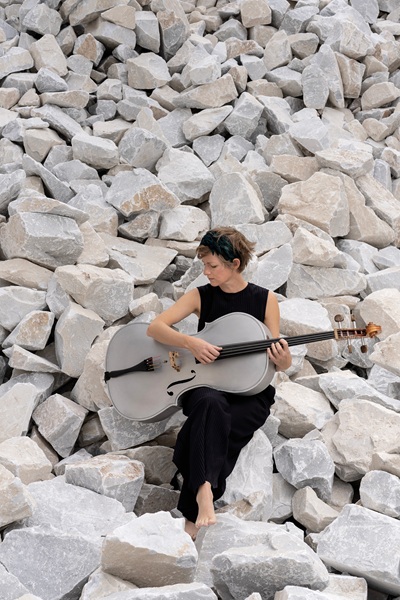
Dalla costa occidentale dell’Irlanda alle Isole Eolie, la violoncellista, cantante e compositrice porta la sua musica alla Tenuta di Castellaro domani sera, un’ora prima del tramonto per “Sunset Live Music”. Tra mare, tramonto, memoria delle isole e il coraggio di Grace O’Malley, Naomi Berrill racconta la storia che sta dietro alla sua musica
di Alessio Cioni
Prima ancora che venga suonata la prima nota, esiste già una storia, e la storia di Naomi Berrill comincia lontano da Lipari, sulla costa occidentale dell’Irlanda, in una famiglia nella quale la musica non è mai stata qualcosa riservato ai professionisti o alle sale da concerto, ma una forma naturale di comunicazione, quasi normale quanto parlare. Entrambi i genitori suonavano e insegnavano musica e, da bambina, Naomi credeva che tutti sapessero cantare e suonare; ancora piccolissima, portava una chitarra agli amici dei genitori e chiedeva loro di cantarle una canzone, un’immagine che forse conteneva già l’essenza dell’artista che sarebbe diventata. Anni dopo, viaggiando in Francia con un’orchestra giovanile locale, sperimentò nuovamente quella stessa forza della musica in una forma diversa, scoprendo durante alcune sessioni musicali con musicisti francesi che le melodie potevano sostituire la lingua e permettere a persone provenienti da culture differenti di comprendersi senza bisogno di parole. Per Naomi la musica è stata comunicazione prima ancora di diventare una professione, e ancora oggi rimane un modo per esprimere emozioni che le parole non sempre riescono a raggiungere.
Questa idea assume un significato particolare quando parla del suo rapporto con le Isole Eolie e delle ragioni per cui esibirsi in un ambiente insulare le appare così naturale. Il suo ultimo album, Inish, prende il titolo da una derivazione inglese della parola irlandese Inis, che significa isola, ed è dedicato alla vita di Inishark e Inishbofin, due isole al largo della costa occidentale dell’Irlanda. Il mare è presente in tutta la sua immaginazione musicale e molte delle sue canzoni sono state composte accanto all’acqua. Portare la sua musica su un’isola come Lipari sembra dunque quasi come entrare in un paesaggio che appartiene già al suo linguaggio artistico.
Naomi si trova attualmente sulla costa sud-orientale di Salina, dove ogni sera osserva in lontananza i colori di Lipari che cambiano. Non ha ancora messo piede sull’isola sulla quale sta per esibirsi e questa distanza ha creato una particolare forma di attesa, fatta di curiosità e aspettativa. «La guardo con curiosità», racconta, aspettando finalmente di scoprire Lipari dall’interno e non più dall’altra parte del mare.
Poi c’è il tramonto, che diventerà parte essenziale del suo concerto alla Tenuta di Castellaro. Circondato da vigneti, terra vulcanica e mare, il paesaggio offrirà una scenografia che nessuno scenografo potrebbe riprodurre. Per Naomi alba e tramonto sono momenti quasi mistici, momenti della giornata nei quali i colori del paesaggio cambiano continuamente e il tempo ordinario sembra rallentare, trasformando la natura stessa in parte della performance. «Il miglior fondale o sistema di illuminazione che si possa desiderare» arriverà dunque direttamente dalla natura, con l’unico elemento imprevedibile che potrebbe preoccuparla: la pioggia. Ma non crede che a Lipari sarà un problema.
Sea Warrior: coraggio, libertà e Grace O’Malley
Il titolo Sea Warrior evoca immediatamente il mare, l’avventura e il coraggio, ma dietro la canzone di Naomi c’è una donna ben precisa: Grace O’Malley, conosciuta in gaelico come Gráinne Ní Mháille, la leggendaria pirata e guerriera del mare irlandese. La canzone fa parte di Inish, un album che racconta la vita delle isole attraverso emozioni contrapposte, dove la bellezza convive con la difficoltà, l’avventura con la solitudine, l’amore con il pericolo e la luce con la perdita. “Inish” è un racconto musicale sulla bellezza delle isole, ma anche sulla forza e sul coraggio dei loro abitanti e sulla dura esistenza delle comunità di pescatori, e questa tensione tra bellezza e difficoltà attraversa l’intero progetto.
In Sea Warrior, Naomi racconta la storia di una giovane donna che osa liberarsi dagli stereotipi femminili del suo tempo. Grace O’Malley si tagliò i capelli, si travestì da uomo e si nascose sulla nave del padre per iniziare la propria carriera in mare, mentre tracce di uno dei suoi insediamenti sono ancora visibili a Inishbofin. Per Naomi, Grace rappresenta molto più di una figura storica: è uno straordinario simbolo di forza femminile, coraggio e fiducia in se stessa, una donna che affrontò l’ignoto senza accettare i limiti che la società nella quale viveva le imponeva. È una storia che va oltre l’Irlanda, perché il mare è sempre stato il luogo dove le persone partono, tornano, scompaiono, sopravvivono e si reinventano.
Nella musica di Naomi, tuttavia, il mare non è soltanto un simbolo di libertà; può rappresentare anche pericolo, incertezza e vulnerabilità. La sua canzone Blue esplora proprio questa dimensione più oscura, immaginando una persona alla deriva in un blu senza fine, circondata soltanto dal mare e dal cielo, finché le acque si scuriscono, arriva una tempesta e la destinazione diventa incerta. La barca riuscirà a raggiungere acque più calme e ad approdare sana e salva su una nuova terra, oppure sarà la tempesta a vincere? Alla fine rimane comunque una luce: forse l’alba, forse la salvezza, forse la luce del cielo. La canzone è stata ispirata in parte da Khaled Hosseini e dal suo Sea Prayer, la toccante storia di un padre che osserva il figlio addormentato prima di un pericoloso viaggio attraverso il mare. Attraverso queste immagini Naomi trasforma l’oceano in qualcosa di molto più grande di un paesaggio. Nella sua musica, il mare diventa confine e passaggio, minaccia e promessa, luogo di separazione e appartenenza.
Quando il violoncello diventa un’altra voce
La libertà di Naomi dai confini musicali affonda le proprie radici nell’ambiente nel quale è cresciuta. Sulla costa occidentale dell’Irlanda, la musica folk irlandese e l’apprendimento a orecchio rappresentavano una parte importante della vita della comunità, mentre i suoi tre fratelli seguivano percorsi musicali differenti: due sono diventati musicisti jazz e un altro musicista folk irlandese. I suoi genitori gestivano una scuola di musica locale dove insegnavano pianoforte, chitarra, violino e canto, oltre a dirigere una società corale. L’infanzia di Naomi era dunque immersa contemporaneamente in diversi linguaggi musicali.
È stato solo quando ha iniziato a studiare musica classica a livello universitario che si è resa conto di quanto le mancassero gli altri generi che avevano sempre fatto parte della sua vita. La svolta è arrivata mentre aspettava il suo primo figlio. In quel periodo lavorava come violoncellista classica in un quartetto d’archi e iniziò a sperimentare il violoncello come strumento di accompagnamento della propria voce. Quella che era cominciata come un’esplorazione divenne progressivamente una nuova identità artistica, permettendo a musica classica, folk irlandese, jazz, arrangiamenti e composizioni originali di convivere nello stesso universo musicale. Naomi comprese infine che quella era la strada creativa nella quale si sentiva più felice, una strada che le consentiva di muoversi tra tradizioni diverse senza lasciare che un’unica etichetta potesse definirla.
Quando canta e suona contemporaneamente il violoncello, non avverte due voci separate o due parti diverse di sé. «Sento che è una sola espressione», spiega, e la semplicità di questa risposta dice molto della sua filosofia artistica. Il violoncello, stretto al corpo, diventa quasi un’altra voce umana, un altro respiro, mentre la sua ricchezza armonica permette allo strumento e alla cantante di diventare parte di un unico gesto musicale.
La nonna che è ancora presente nella musica
Ogni musicista porta dentro di sé ricordi che rimangono nascosti da qualche parte nel suono, e per Naomi uno dei più importanti appartiene alla nonna irlandese Kathleen. Non era una musicista, ma amava profondamente la musica ed era stata un’eccezionale danzatrice irlandese, vincendo da giovane titoli nazionali. Insieme al marito organizzava nella propria casa incontri musicali per i musicisti della comunità, ai quali la madre di Naomi, ancora bambina, assisteva e partecipava suonando.
Quella storia è passata da una generazione all’altra attraverso la musica e a volte le persone che non sono mai salite su un palcoscenico diventano parte della musica di coloro che invece lo fanno. Quando Naomi canta sul palco, sua nonna Kathleen torna spesso alla sua memoria, ricordandole che il ricordo può sopravvivere non soltanto nelle fotografie o nei racconti, ma anche nel suono di una voce e nello spazio emotivo creato da una canzone.
Lipari e il diverso ritmo del tempo delle isole
Naomi conosce già qualcosa delle Isole Eolie. Lo scorso settembre si è esibita a Stromboli in occasione di una mostra dell’artista e pittore Roberto di Alicudi, e lì ha sperimentato quello che definisce un ritmo di vita diverso e bellissimo. È una sensazione che riconosce anche quando visita le piccole isole al largo della costa occidentale dell’Irlanda, dove il tempo sembra rallentare e le persone diventano più attente alle cose che altrimenti rischierebbero di scomparire sotto la velocità della vita quotidiana.
Le isole cambiano il rapporto con il tempo e incoraggiano un modo diverso di guardare il mondo, e per un artista questo può essere prezioso. Alla domanda su cosa possa offrire un’isola come Lipari a un artista che una città non può dare, Naomi risponde con colori, immagini, suoni e profumi, insieme alla possibilità di smettere di correre e semplicemente lasciarsi attraversare da tutto questo. Una risposta che potrebbe quasi descrivere la sua stessa musica, perché il suo lavoro sembra chiedere all’ascoltatore di rallentare e prestare attenzione a ciò che accade intorno e dentro di noi.
Quando la musica diventa condivisa
Il rapporto con il pubblico è un altro elemento fondamentale dei concerti solistici di Naomi. Le piace raccontare le storie legate alle proprie canzoni, permettendo agli spettatori di conoscere la persona che si trova dietro la musicista e, talvolta, quando l’atmosfera lo permette, invita il pubblico a cantare con lei. In quei momenti il concerto diventa qualcosa di simile a una session musicale irlandese, dove tutti si sentono autorizzati a partecipare, anche senza essere musicisti professionisti, e il confine tra artista e pubblico comincia a scomparire.
Quando finalmente l’applauso termina, ciò che rimane può sembrare molto piccolo: forse una melodia, un accordo, un ricordo o un’emozione. Eppure Naomi crede che questi elementi apparentemente semplici possano rimanere dentro una persona per anni. Lo stesso può accadere attraverso le parole che uno spettatore rivolge a un artista dopo un concerto, perché quei momenti rivelano lo straordinario potere della musica di andare oltre la persona che l’ha creata. «Sono momenti nei quali ci rendiamo conto che la musica è una forza molto più grande di noi», dice, descrivendo forse la ragione più profonda per cui un concerto può continuare a esistere molto tempo dopo che l’ultima nota è scomparsa.
Tre immagini per una notte a Lipari
Se potesse descrivere la sua serata alla Tenuta di Castellaro attraverso tre immagini invece che tre parole, Naomi potrebbe scegliere il mare, il tramonto e il suono del violoncello, ma preferisce non decidere prima che l’esperienza sia realmente accaduta. Dovrà aspettare la fine del concerto, perché alcune esperienze non possono essere immaginate in anticipo: devono semplicemente essere vissute.
Forse è proprio questo che rende diverso suonare su un’isola rispetto a un teatro. Il paesaggio non può essere completamente controllato, la luce cambia continuamente, il vento può intervenire e il mare rimane lì, al di là del programma dell’artista, indifferente alle aspettative del palcoscenico. Naomi non teme questa imprevedibilità; spera soltanto che la pioggia rimanga lontana, lasciando tutto il resto al paesaggio e alla musica.
«Sto cercando la bellezza»
Alla fine della conversazione, la domanda diventa più intima. Se la musica è un viaggio, verso dove sta andando oggi Naomi Berrill e che cosa sta ancora cercando? La sua risposta supera la musica e arriva a un’idea più ampia del modo di vivere. «Penso che una cosa molto nobile verso cui tendere sia la bellezza», dice, spiegando che non parla soltanto della bellezza di ciò che creiamo attraverso la musica, ma della bellezza che cerchiamo di mettere in tutto ciò che facciamo come esseri umani durante il tempo che trascorriamo sulla terra: nelle parole, nelle azioni, nel nostro modo di vivere, perché ogni gesto ha delle conseguenze.
Poi ricorda una frase pronunciata dal padre, che trascorre molto del suo tempo nel giardino: «Scava bene, pianta in profondità e con verità, e qualcosa di buono verrà fuori». Sembra un consiglio per chi coltiva un giardino, ma potrebbe essere altrettanto facilmente una filosofia per un artista, o forse per chiunque cerchi di lasciare qualcosa di significativo: scavare in profondità, piantare con sincerità e avere fiducia che, con il tempo, qualcosa di buono possa emergere.
Forse è proprio verso questo che sta andando il viaggio di Naomi Berrill dall’Irlanda a Lipari: verso la bellezza, l’autenticità e la possibilità di creare qualcosa capace di mettere radici. Alla Tenuta di Castellaro, sotto i colori mutevoli del tramonto eoliano, con il mare oltre i vigneti e il paesaggio vulcanico intorno a lei, il suo violoncello racconterà un altro capitolo di questa storia, diventando forse un’altra voce in una conversazione molto più antica: quella tra le persone e le isole, tra la memoria e il mare, tra il luogo da cui veniamo e quello verso cui stiamo ancora cercando di andare.
Giovedì sera, a Tenuta di Castellaro, Naomi Berrill con Sea Warrior
Naomi Berrill in Lipari, when the cello meets the sea: “I am searching for beauty”
From the west coast of Ireland to the Aeolian Islands, the cellist, singer and composer brings her music to Tenuta di Castellaro. Between the sea, sunset, island memories and the courage of Grace O’Malley, Naomi Berrill tells the story behind her music
by Alessio Cioni
Before the first note is played, there is already a story, and Naomi Berrill’s story begins far from Lipari, on the west coast of Ireland, in a family where music was never something reserved for professionals or concert halls, but a natural form of communication, almost as ordinary as speaking. Both her parents played and taught music, and as a little girl Naomi believed that everybody could sing and play; as a toddler, she would take a guitar to her parents’ friends and ask them to sing her a song, an image that perhaps already contained the essence of the artist she would become. Years later, travelling to France with a local youth orchestra, she experienced the same power of music in a different way, discovering during musical sessions with French musicians that melodies could replace language and allow people from different cultures to understand one another without needing words. For Naomi, music was communication before it became a profession, and it remains today a way of expressing emotions that words cannot always reach.
That idea becomes particularly meaningful when she speaks about her relationship with the Aeolian Islands and about the reasons why performing in an island environment feels so natural to her. Her latest album, Inish, takes its title from an English derivation of the Irish word Inis, meaning island, and is dedicated to life on Inishark and Inishbofin, two islands off the west coast of Ireland. The sea is present throughout her musical imagination, and many of her songs were composed beside the water, which is why bringing her music to an island such as Lipari seems almost like entering a landscape that already belongs to her artistic language.
Naomi is currently staying on the south-eastern coast of Salina, where every evening she watches the colours of Lipari changing in the distance. She has not yet set foot on the island where she is about to perform, and this distance has created a particular kind of anticipation, a mixture of curiosity and expectation. “I watch it with curiosity,” she says, looking forward to finally discovering Lipari from within rather than from across the sea.
Then there is the sunset, which will become an essential part of her concert at Tenuta di Castellaro. Surrounded by vineyards, volcanic soil and the sea, the landscape will provide a stage that no theatre designer could reproduce. For Naomi, sunrise and sunset are almost mystical moments, times of day when the colours of the landscape constantly change and ordinary time seems to slow down, making the natural world itself part of the performance. “The best stage backdrop or lighting anyone could want” will therefore come directly from nature, with the only unpredictable element she might worry about being rain, although she does not believe that will be a problem in Lipari.
Sea Warrior: courage, freedom and Grace O’Malley
The title Sea Warrior immediately evokes the sea, adventure and courage, but behind Naomi’s song there is a very specific woman: Grace O’Malley, known in Gaelic as Gráinne Ní Mháille, the legendary Irish pirate and sea warrior. The song is part of Inish, an album that tells the story of island life through contrasting emotions, where beauty exists alongside hardship, adventure beside loneliness, love beside danger and light beside loss. “Inish” is a musical narrative about the beauty of the islands, but also about the strength and courage of their inhabitants and the harsh existence of fishing communities, and this tension between beauty and difficulty runs through the entire project.
In Sea Warrior, Naomi tells the story of a young woman who dares to break away from the female stereotypes of her time. Grace O’Malley cut her hair, disguised herself as a boy and hid aboard her father’s ship in order to begin her career at sea, while traces of one of her settlements can still be found on Inishbofin. For Naomi, Grace represents much more than a historical figure: she is an extraordinary symbol of feminine strength, courage and self-belief, a woman who faced the unknown without accepting the limitations imposed upon her by the society in which she lived. It is a story that resonates beyond Ireland because the sea has always been a place where people leave, return, disappear, survive and reinvent themselves.
Yet in Naomi’s music the sea is not only a symbol of freedom; it can also represent danger, uncertainty and vulnerability. Her song Blue explores precisely this darker dimension, imagining a person drifting in an endless blue, surrounded only by sea and sky, until the waters darken, a storm approaches and the destination becomes uncertain. Will the boat reach calmer waters and arrive safely on new land, or will the storm win? There is still light at the end, perhaps sunrise, perhaps safety, perhaps the light of heaven. The song was partly inspired by Khaled Hosseini’s Sea Prayer, the moving story of a father watching his sleeping son before a dangerous journey across the sea, and through this imagery Naomi transforms the ocean into something much larger than a landscape. In her music, the sea becomes a border and a passage, a threat and a promise, a place of separation and belonging.
When the cello becomes another voice
Naomi’s freedom from musical boundaries is rooted deeply in the environment in which she grew up. On the west coast of Ireland, Irish folk music and learning by ear were an important part of community life, while her three brothers followed different musical paths, with two becoming jazz musicians and another an Irish folk musician. Her parents ran a local music school where they taught piano, guitar, violin and singing, as well as running a choral society, so Naomi’s childhood was surrounded by several musical languages at once.
It was only when she later studied classical music at university level that she realised how much she missed the other genres that had always been part of her life. The turning point came while she was expecting her first child, when she was working as a classical cellist in a string quartet and began experimenting with the cello as an accompanying instrument for her voice. What started as an exploration gradually became a new artistic identity, allowing classical music, Irish folk, jazz, arrangements and original compositions to coexist within the same musical world. Naomi eventually understood that this was the creative path on which she felt happiest, a path in which she could move between traditions without allowing any single label to define her.
When she sings and plays the cello at the same time, she does not experience two separate voices or two different parts of herself. “I feel it is one expression,” she explains, and the simplicity of that answer says much about her artistic philosophy. The cello, held close to the body, becomes almost another human voice, another breath, and its harmonic richness allows the instrument and the singer to become part of a single musical gesture.
The grandmother who is still present in the music
Every musician carries memories that remain hidden somewhere inside the sound, and for Naomi one of the most powerful belongs to her Irish grandmother Kathleen. She was not a musician, but she was a great lover of music and an exceptional Irish dancer who won national championship titles as a young woman. Together with Naomi’s grandfather, she organised musical gatherings for local musicians in their home, where Naomi’s mother, still a child, would listen and play along.
That story has continued from one generation to another through music, and sometimes the people who never stood on a stage become part of the music of those who do. Whenever Naomi sings on stage, her grandmother Kathleen often comes back to her, a reminder that memory can survive not only in photographs or stories, but also in the sound of a voice and in the emotional space created by a song.
Lipari and the different rhythm of island time
Naomi already knows something about the Aeolian Islands. Last September she performed on Stromboli for an exhibition by the artist and painter Roberto di Alicudi, and there she experienced what she describes as a different and beautiful rhythm of life. She recognises the same feeling when she visits the small islands off the west coast of Ireland, where time seems to slow down and people become more attentive to things that might otherwise disappear beneath the speed of everyday life.
Islands change the relationship with time and encourage a different way of looking at the world, and for an artist that can be precious. Asked what an island such as Lipari can give an artist that a city cannot, Naomi answers with colours, images, sounds and scents, together with the ability to stop rushing around and simply take these things in. It is an answer that could almost describe her music itself, because her work seems to ask the listener to slow down and pay attention to what is happening around and within us.
When the music becomes shared
The relationship with the audience is another essential part of Naomi’s solo performances. She likes to tell stories connected to her songs, allowing people to discover the person behind the musician, and sometimes, when the atmosphere feels right, she invites the audience to sing with her. In those moments, the concert becomes something closer to an Irish musical session, where everybody feels entitled to participate, even without being a professional musician, and the boundary between performer and audience begins to disappear.
When the applause finally ends, what remains may seem very small, perhaps a melody, a chord, a memory or an emotion, yet Naomi believes that these apparently simple elements can remain inside someone for years. The same can happen through the words an audience member gives an artist after a concert, because those moments reveal the extraordinary power of music to move beyond the person who created it. “These are moments when we realise that music is a power much greater than us,” she says, describing perhaps the deepest reason why a concert can continue to exist long after the final note has disappeared.
Three images for a night in Lipari
If she could describe her evening at Tenuta di Castellaro through three images rather than three words, Naomi might choose the sea, the sunset and the sound of the cello, but she prefers not to decide before the experience has actually happened. She will have to wait until after the concert, because some experiences cannot be imagined in advance and must simply be lived.
Perhaps this is precisely what makes performing on an island different from performing in a theatre. The landscape cannot be completely controlled, the light changes continuously, the wind can intervene and the sea remains there beyond the artist’s programme, indifferent to the expectations of the stage. Naomi is not afraid of this unpredictability; she only hopes that the rain stays away, leaving the rest to the landscape and to the music.
“I am searching for beauty”
At the end of the conversation, the question becomes more intimate. If music is a journey, where is Naomi Berrill travelling now, and what is she still searching for? Her answer goes beyond music and reaches into a broader idea of how to live. “I think something very noble to strive towards is beauty,” she says, explaining that she is not speaking only about beauty in what we create through music, but about beauty in everything human beings do during the time they spend on earth: their words, their actions, their way of life, because every gesture has consequences.
Then she remembers a sentence spoken by her father, who spends much of his time in the garden: “Dig well, plant deep and true, and something good will show through.” It sounds like gardening advice, but it could just as easily be a philosophy for an artist, or perhaps for anyone trying to leave something meaningful behind: to dig deeply, to plant with sincerity and to trust that, in time, something good may emerge.
Perhaps that is where Naomi Berrill’s journey from Ireland to Lipari is heading, towards beauty, authenticity and the possibility of creating something capable of putting down roots. At Tenuta di Castellaro, beneath the changing colours of the Aeolian sunset, with the sea beyond the vineyards and the volcanic landscape around her, her cello will tell another part of that story, becoming perhaps another voice in a much older conversation: the conversation between people and islands, between memory and the sea, between where we come from and where we are still searching to go.